

Photography: Yonatan Weitzman
Local Testimony 2006
Gallery
2006
Photo of the Year | News | Daily Life | Portraits | Culture and Art | Nature and Environment | Sport
Levia Stern, Aamer Dirbas, Miki Kratsman, Naama Haikin, Aryeh Sagie (Sachi), Yon Feder, David Adika, Prof Arik Carmon




Photo of the year

EPA
Pavel Wolbrg
August 4 2006, ten days before the ceasefire. As the IDF broadened its operation in southern Lebanon with numerous ground forces, Hizballah’s rocket volleys intensified. One of the Katyushas made a direct hit on a private car, setting it afire, on a street in Kiryat Shmonah.
News

Series
News
Yoav Galai
Yediot Aharonot
On August 12 2006 combat-engineering soldiers entered the village of Inta, which is at the outskirts of Bint Jbeil, on their way north. The soldiers broke into a school in the town to set up a field clinic for comrades who were wounded on the way. While they were preparing the clinic, six Sagger missiles were fired at them, and eight of the engineering soldiers, including the medics and the doctor, were wounded
Series of the year

1st prize
Single
News
AP
Ariel Schalit
March 21 2006: A warning that terrorists are on their way to an attack in the center of the country gets the security forces into action. Intelligence reports that a commercial vehicle is carrying Palestinians with explosives, and the security forces launch a race against time. After a dramatic chase, the vehicle is stopped next to Latrun. The suspects were stripped, their eyes covered, and their hands cuffed, and two soldiers with covered faces were stationed to guard them.
2nd prize
Single
News
Rina Castelnuovo Hollander
New York Times
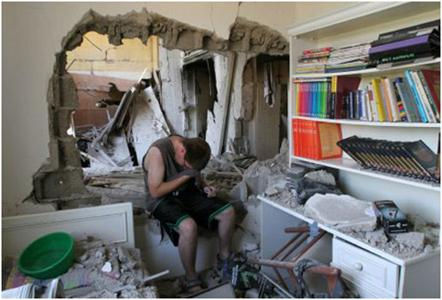
On August 6 a fatal rocket volley was fired from southern Lebanon at Kibbutz Cfar Giladi. One rocket landed not far from the statue of the roaring lion, at a spot where soldiers from a reserve paratrooper brigade were gathered who had been mobilized that same morning, and twelve of the soldiers were killed. A few hours later a rocket landed in the bedroom of Yaniv Bornstein, a 21-year-old soldier who had come home on leave. He found that the wall of his room was shattered but his bookcase remained intact.

3rd prize
Single
News
Max Yelinson
Maariv
The security forces try to clear a path through the ruins so as to rescue a severely injured man, completely covered with dust, who was left sitting on his chair on his balcony after a Katyusha hit his building on Nahalal Street in the Bat Galim neighborhood of Haifa. The Katyusha caused two of the building’s three stories to collapse and injured 11 people (July 17 2006).

1st prize
Series
News
Getty Images
Uriel Sinai
Haaretz
A man from Zaka, a service for collecting body parts after terror attacks, in the railroad garage in Haifa where eight people were killed in a direct hit by a missile. Dozens of workers were injured. There was great destruction at the site and many of the workers stood dumbfounded.

2nd prize
Series
News
Independent
Eldad Rafaeli

3rd prize
Series
News
Reuters
Yonathan Weitzman
Paratroopers at the funeral of Staff Sergeant Oren Lifschitz, 21 years old, from Kibbutz Gazit. Oren was killed on August 8 2006 in a rescue attempt in Bint Jbeil for his wounded friend Moran Cohen, who had been severely wounded during a military operation in the village. At the end of the heroic rescue attempt two soldiers were killed.
Daily Life

1st prize
Single
Daily life
Max Yelinson
Maariv
Palestinian businesspeople from the Gaza Strip and the West Bank in a tour of Haifa port organized by the Peres Peace Center. Haifa port, a well-preserved location and one of the sensitive border points of the country, opened its gates and hosted the businesspeople, some of whom had been prohibited to enter Israel in the past. The Peres Peace Center holds many activities to promote economic cooperation between Israelis and Palestinians.

2nd prize
Single
Daily life
AP
Oded Balilty
I’ve got wings: the family of a new air force pilot wears airplane-shaped hats in a ceremony for completion of the piloting course at the air force base in Hatzarim. The course last three years and is considered one of the most difficult and prestigious in the IDF. Beginning in 1995, after a ruling by the Supreme Court, the course has also been open to women.

3rd prize
Single
Daily life
EPI
Pavel Wolberg
Since the separation fence was built between Bethlehem residents and their workplaces in Israel, every morning workers from Bethlehem have stood in line at the roadblock by the entrance to Jerusalem, aiming to cross to the other side and get to work.

1st prize
Series
Daily life
Independent
Danny Yanai
At the age of four months Sivan, a healthy and cheerful baby, was diagnosed with leukemia. Since then the family’s world has been turned upside down, all of them recruited to Sivan’s struggle for life. In the hospital Sivan is undergoing difficult chemotherapeutic treatments and bravely fighting for her life. Her father Danny is documenting Sivan from the day of her birth to her illness and the beginning of her young life among the tubes and syringes. He hopes to give her the photo album as a keepsake when she gets older and recuperates.

2nd prize
Series
Daily life
Independent
David Evan
The children of Dudi Even lost their mother and after that underwent a period of adjusting to their new mother and sister. A joint trek through the desert created a different connection between the family members, and mirrored the psychological journey each of them had to take

3rd prize
Series
Daily life
Independent
Amnon Gutman
For about a year the photographer Amnon Gutman was attached to a mobile intensive-care unit of Magen David Adom (Red Star of David) in Tel Aviv, and was exposed to the less heroic side of their routine activities. With each call the intensive-care crew enters a moment of people’s lives, which sometimes ends in the emergency room and sometimes in an announcement of death.
Potrtaits

1st prize
Single
Portraits
Maan Images
Wissam Nassar
A Palestinian girl grieves at the funeral of Amana Hajaji, 43, and her children Rawan, 6, and Muhammad, 23, who were killed in an explosion at their home in the Sajiya neighborhood of Gaza in September 2006. The explosion also injured five other members of the family. Although, at the time of the explosion, air force planes were attacking targets in Gaza, the IDF did not take responsibility for the incident. During January-October 2006, the Israeli-Palestinian conflict took the lives of over 500 Palestinians, about half of them civilians who did not take part in the fighting, including many children (over 100 minors). In this same period 5 soldiers and 15 civilians were killed on the Israeli side, including one teenage boy (data of the Betselem organization).

2nd prize
Single
Portraits
Reuters
Ronen Zvulun
February 26 2006. In a visit to the Shama settlement in southern Mount Hebron, during an intensive election campaign, Labor Party chairman Amir Peretz found a moment’s rest on a rock at the outskirts of the settlement. Having served as a workers’ representative for years, Peretz carried the social banner in the campaign, and the party he headed won 19 mandates. Eventually Peretz was appointed defense minister in the government of Ehud Olmert; a short time later the two led Israel in the war against Hizballah.

3rd prize
Single
Portraits
Eric Sultan
Maariv
President Moshe Katsav and his wife Gila, in gowns and sterile gloves, in a visit to the nanotech labs at Tel Aviv University. A guest at the nanotech labs has to be spotlessly clean since even dust particles can cause damage to the sensitive lab equipment.

1st prize
Series
Portraits
Independent
Eyal Fried
A group of Red Army veterans celebrates 61 years since the Allied defeat of Nazi Germany at a restaurant in Ashdod. The day of the victory over the Nazis gets lots of attention in the Russian media in Israel, which emphasizes the important role of the Soviet Union in World War II and of course the role of the Jewish soldiers. According to the National Veterans Organization, about half a million Jews fought against the Nazis in the ranks of the Red Army.

2nd prize
Series
Portraits
Freelance
Miriam Tsachi
A resident of Elon Moreh in Samaria provides treatment at the “Vineyard,” a center for holistic therapies in the spirit of Judaism at Elon Moreh. The center is operated by eight women from the settlement who offer different treatments such as Raiki, reflexology, homeopathy, and so on. In doing so the women have the blessing of the rabbi of the settlement, who said that God, Blessed Be He, bestowed energies on the world and the time has come for Judaism, too, to utilize them.

3rd prize
Series
Portraits
David Bachar
Haaretz
When he was six, the father of Omerio Balda Pinto of the West African country of Guinea-Bisseau sold him to a tribal leader in return for a promise that he would bestow a blessing on the father’s home. The tribal leader made the boy a slave. After years of cruelty and grinding work Omerio managed to flee, and at age 12 he was able for the first time to realize his dream of going to school. Later he became politically active and was persecuted by the government until at age 16 he had to flee the country. With the help of forged papers he reached Cairo, and from there stole across the border to Israel. Omerio was caught by the immigration police and spent three months in prison. He is now trying to obtain a passport, and dreams of finding a university that will accept him.
Culture and Art

1st prize
Single
Culture and art
Independent
Natan Dvir
Visitors at the fundraising exhibition of the Committee for the War on AIDS in the administration building of Bank Hapoalim in Tel Aviv. According to data of the Ministry of Health, there are currently 4,500 AIDS carriers and patients in Israel. The Committee for the War on AIDS is a nonprofit organization that has already worked for over 20 years to strengthen awareness of the disease, promote the rights of the patients, and improve the quality of life of those who have caught the HIV virus.

2nd prize
Single
Culture and art
Independent
Eyal Landesman
The actor Salim Dau in a moment of the play Album, which was staged at the Acre Festival 2005. The hero of Album is a person who in his latter years looks back at his life and tries unsuccessfully to classify the different moments, the more and less significant ones. Each memory turns into a picture, and each picture into a theatrical moment. According to the authors of the play, Chaim Yafim Barvalet, Eyal Landsman, and Amir Nizar Zoavi, it seeks to examine the elusiveness of the moment and of life.

3rd prize
Single
Culture and art
Independent
Liron Breier

1st prize
Series
Culture and art
Nir Kafri
Haaretz
In March 2006, for the first time in its history, Israel hosted the world championship in parlor and Latin dancing. 200 dance couples made it to the championship and competed for the coveted cup. Although Israeli dancers did well, the cup was taken by a couple from Ukraine

2nd prize
Series
Culture and art
Flash 90
Michal Fattal
Since its establishment, the night club Ha’uman 17 in Jerusalem has become a symbol of the city’s nightlife, drawing revelers even from Tel Aviv. After becoming one of the best-known, if not the most famous club in Israel, Ha’uman 17 spread the word outside Jerusalem as well and opened clubs in Haifa and Tel Aviv, which have the same name.
In this series Michal Fattal focuses on the subtle happenings and fascinating interactions at the borders of life in these clubs. She explores the different expressions of femininity in the dim recesses of the nightlife: between temptation and victimization, between power and submission.

3rd prize
Series
Culture and art
BauBau
Daniel Bar-on
Haaretz
Christian believers in the Holy Fire ceremony at the Church of the Holy Sepulcher in the Old City of Jerusalem. The Sabbath of Light, which falls before Easter, is the time for the most sacred ceremony in Eastern Christianity: a fire is kindled at the Church of the Holy Sepulcher and from there, according to Christian tradition, is disseminated to the whole world. The fire symbolizes the presence of God, and the passage from the darkness of Jesus’ death to the light of his resurrection (April 22 2006).
Nature and Environment

1st prize
Single
Nature and environment
Getty Images
Uriel Sinai
Haaretz
Putting out a fire caused by Katyusha strikes. During the war enormous damage was caused to the green spaces of the north: about 3,000 acres of forest and natural vegetation caught fire as well as 10,000 acres of pastureland. During the war the firefighters together with Keren Kayemet L’Israel fought the many forest fires, and after each alarm and announcement that the missiles had struck an open area, many volunteers went on the firefighting mission. The fires also harmed great numbers of animals—forest residents including birds, reptiles, and mammals. According to Keren Kayemet L’Israel, only in another 50 years will the forests again be what they were before the war.

2nd prize
Single
Nature and environment
Nazca Pictures
Carmit Hassine
A goat, resident of the petting zoo in Rishon Letzion, directs a gaze at the camera. The goat was first domesticated ten thousand years ago, and since then people have exploited her for their needs: benefiting from the milk that she gives, the soft wool that is sheared from her, and sometimes also from her skin and meat.

3rd prize
Single
Nature and environment
Eli Atias
Two apples on this tree survived the cold winter that beset the Golan Heights

1st prize
Series
Nature and environment
Independent
Shai Kremer
The “Infected Landscape” series has for five years been observing natural landscapes and interior spaces that bear marks of the violence of the Arab-Israeli conflict, and shows how military activity affects the landscape. “Infected Landscape” tries to restore the ethical dimension and political baggage to the familiar images of the Golan Heights

2nd prize
Series
Nature and environment
Independent
David Pilosof
he Etgarim (Challenges) NGO works to rehabilitate children, teenagers, and adults with disabilities through challenging sports activities. With the help of special equipment, a professional team of counselors and, in particular, great faith in human capacities and spirit, Etgarim enables each person, with almost any type of disability, to ski on snowy mountains, parachute, make it through survival workshops in nature, and engage in a wide variety of challenging sports in the air, land, and sea.
The pictures in “Local Testimony” were photographed as part of a public relations project aimed at mobilizing contributions to the NGO. David Pilosof (Pilo) has for many years engaged in underwater photography and publishing magazines and books about the sea

3rd prize
Series
Nature and environment
Independent
Edward Kaprov
A cave in the bowels of Mount Sodom, which is beside the Dead Sea. Mount Sodom is a unique geological phenomenon: a mountain made out of salt, and inside it many kilometers of meandering Karstean caves and tunnels ornamented with giant salt crystals. In the cave in the picture, movement is difficult, and the spectacular salt ceiling almost touches the water course of the underground lake at the heart of the mountain.
Sport

1st prize
Single
sport
Flash 90
pierre Terdjman
A fiercely played soccer game on an improvised field in Abu Dis, the eastern suburb of Jerusalem, in the shadow of the gray concrete of the separation fence.

2nd prize
Single
sport
AP
Ariel Schalit
The tattooed hand of Marcus Hayslip, a player for Ulkar Istanbul, gets to the ball before the hand of Yaniv Green of Maccabee Tel Aviv. The game was played at Yad Eliyahu in the top-16 stage of the EuroLeague. Hayslip’s exploit didn’t help since Maccabee won 84:78. Later in the season Maccabee made it to the championship game but didn’t succeed at defending its title, losing to CSKA

3rd prize
Single
sport
Roni Schutzer
Mazen Ghanayim, chairman of the Bnei Sakhnin soccer team, is attacked by some of the team’s fans after it lost 3:0 to S.C. Ashdod at Doha, Bnei Sakhnin’s home court. In 2003 Bnei Sakhnin acceded to the Premier League, and it was the first Arab soccer team to win the National Cup, doing so under the management of Ghanayim, a well-liked and affable person, and exceptional in the landscape of Israeli soccer. At the end of the 2006 season, after playing in the Premier League for three seasons, Bnei Sakhnin dropped down to the National League.

1st prize
Series
sport
Tomer Appelbaum
Haaretz
A basketball game at sunset on a neighborhood court in Raanana

2nd prize
Series
sport
Nir Keidar
Haaretz
Sport fans

3rd prize
Series
sport
Michal Peleg
June 17 2006, a few minutes before eight in the morning. 1500 triathlonists wait at the starting line of the Tel Aviv Triathlon on Metzitzim Beach, and leap into action for one of the most difficult and demanding of sports competitions. After they finish the swimming part, they come out of the water and get on bicycles, and after that many kilometers of running still await them.